

-
 DHIS2 started a new discussion, Webinars: Using DHIS2 for Immunization, Surveillance & Electronic Medical Records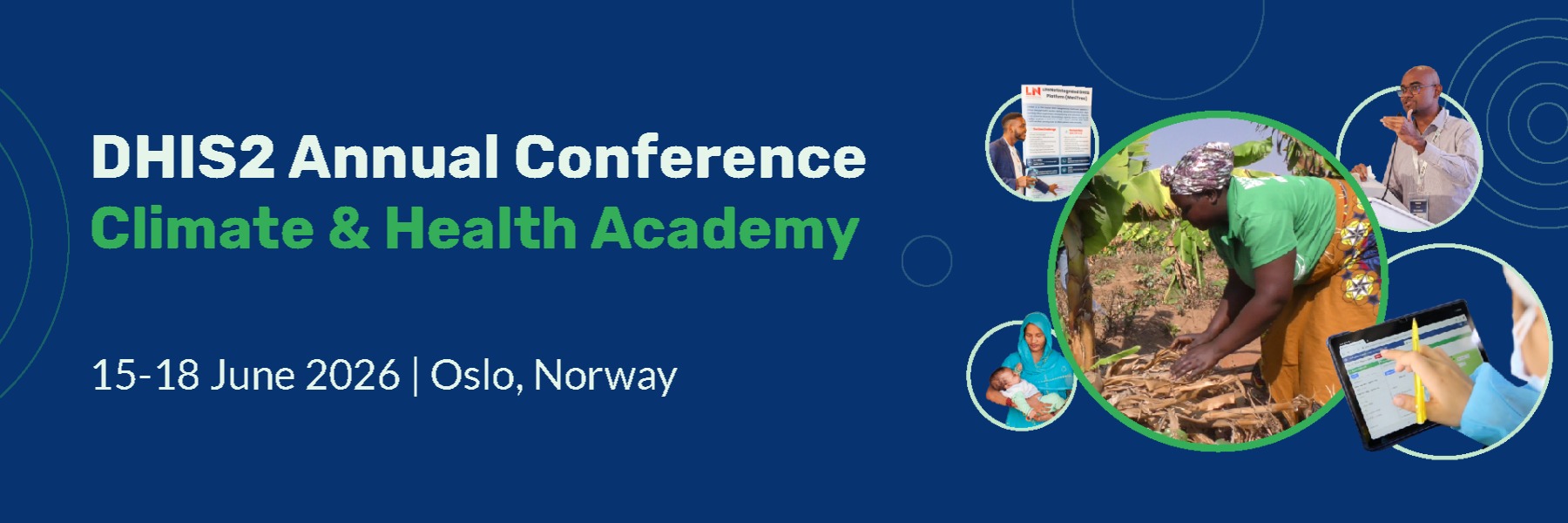
DHIS2 is one of the world's most widely used health information platforms — but are you getting the most out of it? Join us online for these topical sessions during the 2026 DHIS2 Annual Conference to take a practical look at how DHIS2 can be configured and used across three core areas of health service delivery and data management.
Whether you're implementing a new system or looking to strengthen what you already have, these sessions will give you actionable insights you can bring back to your work.
- 15 June, 15:00 CET: "Pandemic and epidemic intelligence for resilient health systems"
- 16 June, 15:00 CET: "DHIS2 in fragile and humanitarian settings"
- 17 June, 13:20 CET: "Functionality and extensions to maps, GIS and population data in DHIS2"
- 17 June, 15:00 CET: "Tracker as a lightweight EMR in PHC"
- 18 June, 10:00 CET: "DHIS2 for cancer registries in Rwanda and Kenya"
Ready to join us? Register here and we will send you the links to join each of these sessions directly!
...MoreDHIS2 is one of the world's most widely used health information platforms — but are you getting the most out of it? Join us online for these topical sessions during the 2026 DHIS2 Annual Conference to take a practical look at how DHIS2 can be configured and used across three core areas of health service delivery and data management.
Whether you're implementing a new system or looking to strengthen what you already have, these sessions will give you actionable insights you can bring back to your work.
- 15 June, 15:00 CET: "Pandemic and epidemic intelligence for resilient health systems"
- 16 June, 15:00 CET: "DHIS2 in fragile and humanitarian settings"
- 17 June, 13:20 CET: "Functionality and extensions to maps, GIS and population data in DHIS2"
- 17 June, 15:00 CET: "Tracker as a lightweight EMR in PHC"
- 18 June, 10:00 CET: "DHIS2 for cancer registries in Rwanda and Kenya"
Ready to join us? Register here and we will send you the links to join each of these sessions directly!
Post is under moderationStream item published successfully. Item will now be visible on your stream.
DHIS2 started a new discussion, DHIS2 Webinar: Immunization Microplanning with WorldPop data, 23 April at 14:00 CETJoin our Webinar on Immunization microplanning with WorldPop data in DHIS2 / Avec l'interprétation simultanée en français
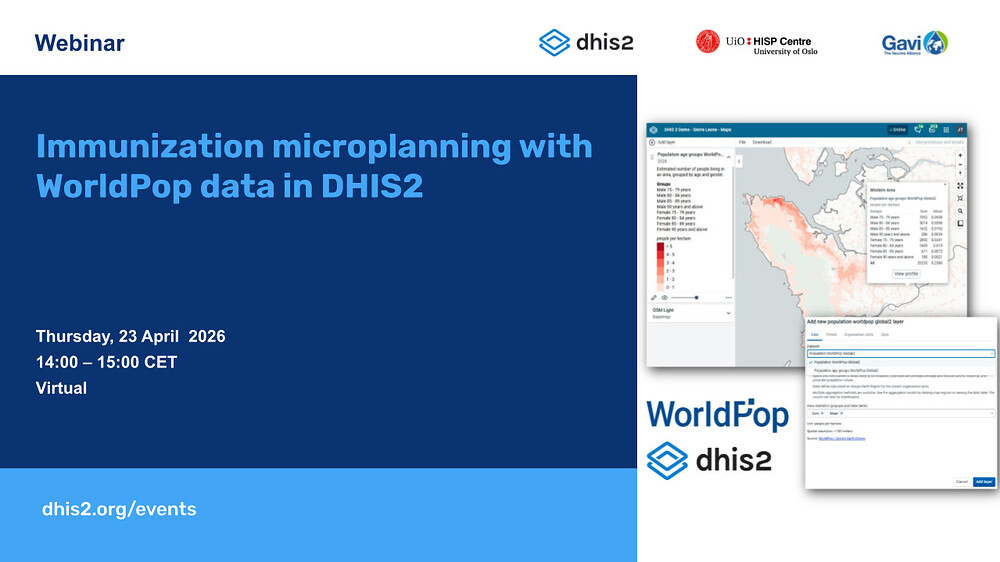
Microplanning for immunization is an approach that helps health workers reach every community with immunization services by identifying priority communities and potential barriers and developing detailed workplans with solutions. In order to develop an effective microplan, access to detailed and accurate population data is critical.
In this webinar, we will present innovative ways to leverage high-resolution annual population estimates from WorldPop in DHIS2 to strengthen immunization microplanning. We will start with a general introduction to immunization microplanning, followed by a presentation of a real-world use case from the Central African Republic by HISP Rwanda. The WorldPop team from the University of Southampton will then provide more information about the Global 2 dataset and the team from HISP UiO will demonstrate its integration in DHIS2.
Reser...
Post is under moderationStream item published successfully. Item will now be visible on your stream.
DHIS2 started a new discussion, Immunization Webinar: Leveraging Chap and the DHIS2 platform for stock forecastingLeveraging Chap and the DHIS2 platform for stock forecasting
Tuesday, 27 January 2026
14:00 – 15:00 CET
Virtual - En ligne
Le webinaire disposera d’une interprétation simultanée en françaisReliable health supply chains are vital for patient care, and stock availability serves as a key performance indicator. Both stockouts and overstocks can harm service delivery and lead to waste.
This webinar will present research on using the Chap platform with DHIS2 to generate stock forecasts and improve demand planning. We’ll cover how last‑mile stock data can be collected and analyzed, how machine learning supports forecasting and inventory decisions, and include a live demo and Q&A.
Register now: https://dhis2.org/events/webinar-chap-for-stock-forecasting/
...Post is under moderationStream item published successfully. Item will now be visible on your stream.
DHIS2 started a new discussion, DHIS2-Gavi Webinar: DHIS2 Climate and Health Tools for Planning and Monitoring Immunization Programmes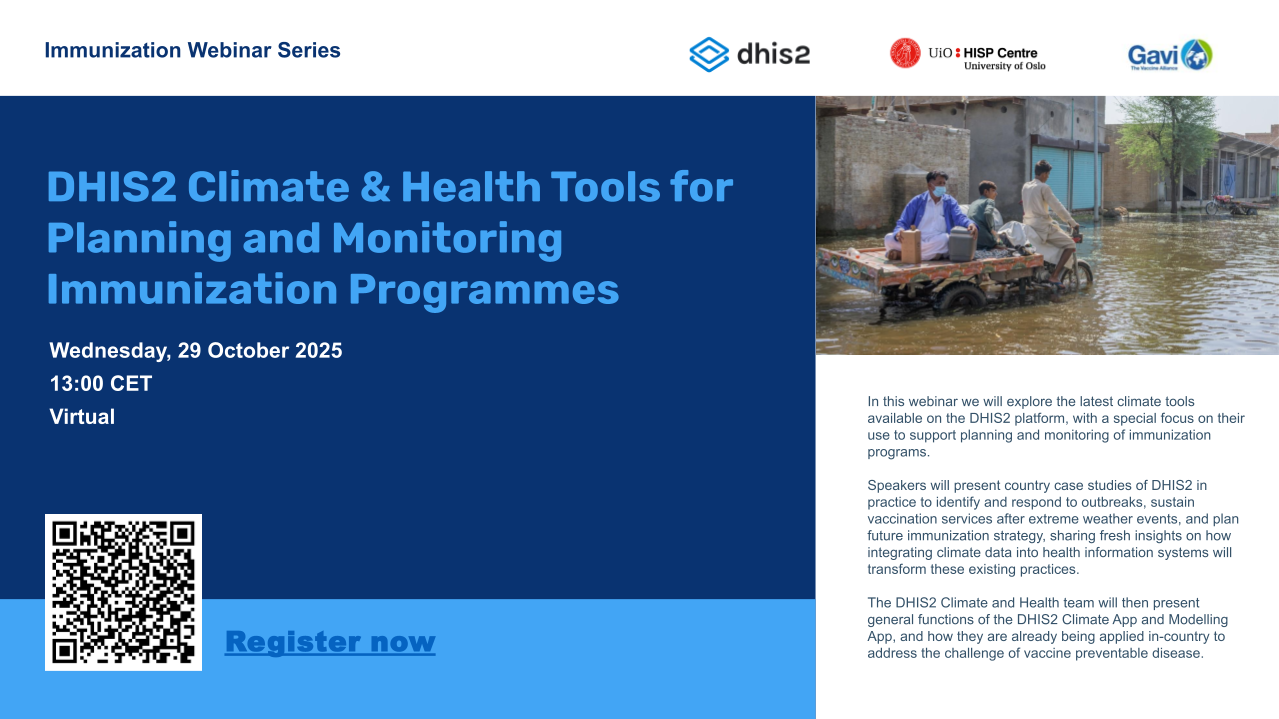
On behalf of the HISP Centre at the University of Oslo, we invite you to join this exciting webinar!
Webinar: DHIS2 Climate and Health Tools for Planning and Monitoring Immunization Programmes
Wednesday, 29 October, 13:00-14:00 CET
Registration: https://dhis2.org/events/climate-and-health-tools-immunization-programs/
Le webinaire disposera d’une interprétation simultanée en françaisWe will explore the latest climate tools available on the DHIS2 platform, with a special focus on their use to support planning and monitoring of national immunization programs.
Speakers will present country case studies of DHIS2 in practice to identify and respond to outbreaks, sustain vaccination services after extreme weather events, and plan future immunization strategy, sharing fresh insights on how integrating climate data into health information systems will transform these existing practices.
The DHIS2 Climate and Health team will then present functions of the DHIS2 Climate App and...
MoreOn behalf of the HISP Centre at the University of Oslo, we invite you to join this exciting webinar!
Webinar: DHIS2 Climate and Health Tools for Planning and Monitoring Immunization Programmes
Wednesday, 29 October, 13:00-14:00 CET
Registration: https://dhis2.org/events/climate-and-health-tools-immunization-programs/
Le webinaire disposera d’une interprétation simultanée en françaisWe will explore the latest climate tools available on the DHIS2 platform, with a special focus on their use to support planning and monitoring of national immunization programs.
Speakers will present country case studies of DHIS2 in practice to identify and respond to outbreaks, sustain vaccination services after extreme weather events, and plan future immunization strategy, sharing fresh insights on how integrating climate data into health information systems will transform these existing practices.
The DHIS2 Climate and Health team will then present functions of the DHIS2 Climate App and Modelling App, such as tailoring and running disease forecasts based on national surveillance data. We will also share latest updates on how these tools are currently being applied in-country to address the challenge of vaccine preventable disease, such as:
- Subnational risk mapping for yellow fever preparedness in Uganda
- Flash flood preparedness at health facilities in Vietnam
- Projecting stock requirements with climate data.
There will be an opportunity for questions to explore how country integration of climate and health data within DHIS2 can deliver predictive intelligence for more climate-resilient immunization programs.
Don't miss out! Register now, share this invitation with colleagues, and join us in advancing immunization efforts globally!
Post is under moderationStream item published successfully. Item will now be visible on your stream.
DHIS2 started a new discussion, DHIS2-Gavi Webinar: "Integrated Health Campaigns and Immunization," 10 June at 15:00 CETWEBINAR: "Integrated Health Campaigns and Immunization"
🗓️ Thursday, 10 June at 15:00 CET
🔗 Register now: https://buff.ly/rmZxDI4This webinar will highlight recent work in the DHIS2 software and documentation/guidance to enhance DHIS2 for planning, monitoring and evaluation of integrated health campaigns. Alongside these updates, the session will feature stories from the field on campaigns, how countries integrate campaign data into their routine immunization and HMIS workflows, as well as non-campaign immunization use cases—sharing real-world experiences, successes, and challenges. Through presentations from the HISP Centre at the University of Oslo, HISP Tanzania (on behalf of Ministry of Health Somalia), and UNICEF, participants will gain insights into practical solutions, challenges and lessons learned from implementations, and how the new DHIS2 enhancements will contribute to meeting these needs.
This event is hosted as part of the Gavi-sponsored DHIS2 for Immunization...
Post is under moderationStream item published successfully. Item will now be visible on your stream.
DHIS2 started a new discussion, WEBINAR: “One Year of EIR Implementation in Laos and the Path to FHIR”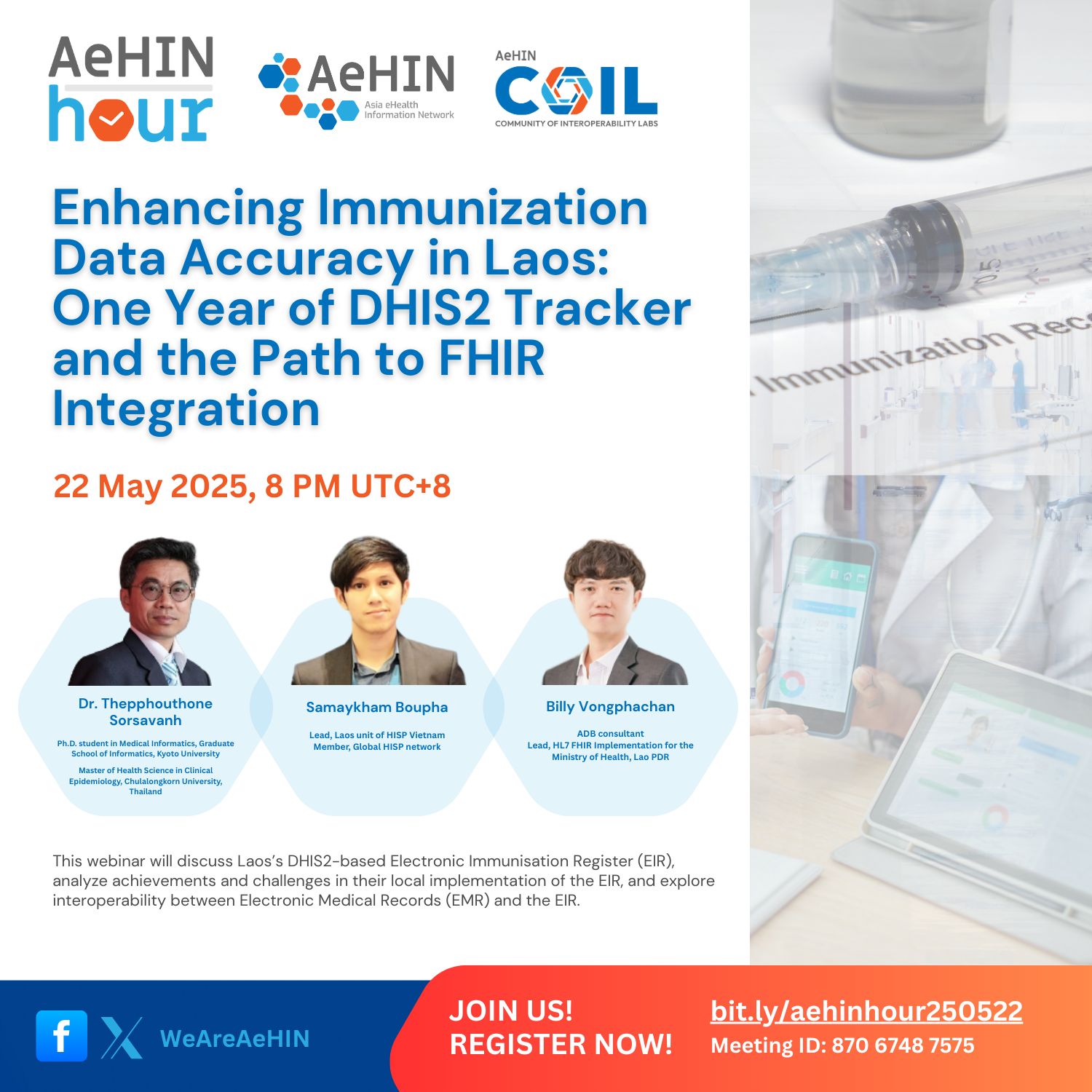
Don't miss this exciting webinar, Thursday, 22 May at 14:00 CET (20:00 UTC+8).
...
🔗 Register here: https://buff.ly/gop07Re
Our DHIS2 implementation partners at HISP Vietnam will share how they are supporting the Ministry of Health of Laos in using DHIS2 for Electronic Immunization Registry (EIR), including:
🔎 Local adaptation of the DHIS2 EIR Health Data Toolkit
🔎 Data use
🔎 Key achievements and ongoing challenges
🔎 Integration with other health services in DHIS2
With DHIS2, Laos is shifting from program-based data systems to a more integrated, patient-centered approach—enabling better vaccination tracking and improving child health outcomes.
#DHIS2 #Laos #Immunization #PublicHealth #FHIR #OpenSourcePost is under moderationStream item published successfully. Item will now be visible on your stream.
DHIS2 is now following Jean Claude ALOTI BOKOKEPost is under moderationStream item published successfully. Item will now be visible on your stream.
DHIS2 is now following Lee Shanta MondolPost is under moderationStream item published successfully. Item will now be visible on your stream.
DHIS2 started a new discussion, DHIS2/Berlinger Device CompatibilityDID YOU KNOW? 🧊 Fridge-tags, Q-tags and SmartSystem by Berlinger are all *validated compatible* with the DHIS2 platform! These solutions can now be easily integrated, allowing temperature data to be incorporated with the DHIS2 system to provide users with analytics and insights for cold chain equipment monitoring.
This integration with tools from Berlinger, a manufacturer of cold chain monitoring equipment for the medical and pharmaceutical industries, meets the World Health Organization (WHO) equipment monitoring system standard for immunization programs. 💉
Learn more about DHIS2 for Logistics: https://buff.ly/r0YYELh
...Post is under moderationStream item published successfully. Item will now be visible on your stream.
DHIS2 started a new discussion, DHIS2/Berlinger Device CompatibilityDID YOU KNOW? 🧊 Fridge-tags, Q-tags and SmartSystem by Berlinger are all *validated compatible* with the DHIS2 platform! These solutions can now be easily integrated, allowing temperature data to be incorporated with the DHIS2 system to provide users with analytics and insights for cold chain equipment monitoring.
This integration with tools from Berlinger, a manufacturer of cold chain monitoring equipment for the medical and pharmaceutical industries, meets the World Health Organization (WHO) equipment monitoring system standard for immunization programs. 💉
Learn more about DHIS2 for Logistics: https://buff.ly/r0YYELh
...Post is under moderationStream item published successfully. Item will now be visible on your stream.
DHIS2 started a new discussion, DHIS2 Immunization webinar: Big Catch-up module launch - 12 Feb 15:00 CETThe DHIS2 team at HISP University of Oslo invites you to our upcoming webinar!Webinar: Big Catch-up Module Launch
Wednesday, 12 February, 15-16:00 CET
Registration: https://us06web.zoom.us/meeting/register/VPCCBJOHTKed0YNMOhxrZQ
Le webinaire disposera d’une interprétation simultanée en françaisWe’re excited to invite you to our upcoming DHIS2 Gavi Quarterly Webinar, where we will spotlight the Big Catch-up (BCU) — a global initiative supported by Gavi, WHO, UNICEF, and partners to restore immunization coverage to pre-pandemic levels and strengthen health systems worldwide.This webinar will cover:- Introduction to the Big Catch-up initiative’s goal, objectives, and progress,
- The official launch of the DHIS2 BCU module, developed in collaboration with Gavi, UNICEF, WHO, and HISP to support reporting and monitoring of catch-up doses and data-driven decision-making,
- Live demo and discussion on how the DHIS2 BCU module enhances the DHIS2 Immunization Toolkit to help...
MoreThe DHIS2 team at HISP University of Oslo invites you to our upcoming webinar!Webinar: Big Catch-up Module Launch
Wednesday, 12 February, 15-16:00 CET
Registration: https://us06web.zoom.us/meeting/register/VPCCBJOHTKed0YNMOhxrZQ
Le webinaire disposera d’une interprétation simultanée en françaisWe’re excited to invite you to our upcoming DHIS2 Gavi Quarterly Webinar, where we will spotlight the Big Catch-up (BCU) — a global initiative supported by Gavi, WHO, UNICEF, and partners to restore immunization coverage to pre-pandemic levels and strengthen health systems worldwide.This webinar will cover:- Introduction to the Big Catch-up initiative’s goal, objectives, and progress,
- The official launch of the DHIS2 BCU module, developed in collaboration with Gavi, UNICEF, WHO, and HISP to support reporting and monitoring of catch-up doses and data-driven decision-making,
- Live demo and discussion on how the DHIS2 BCU module enhances the DHIS2 Immunization Toolkit to help countries improve coverage and catch up on missed vaccinations.
This module is designed to support all countries implementing catch-up strategies — whether as part of the BCU or broader immunization recovery efforts. This is an opportunity to engage with experts, ask questions, and explore how digital solutions can help countries close immunization gaps.Don’t miss out: register now, share this invitation with relevant colleagues, and join us in advancing immunization efforts globally!Best,Max Krafft
Communications Lead
DHIS2 core team
HISP Centre, University of Oslo
dhis2.org | hisp.uio.noPost is under moderationStream item published successfully. Item will now be visible on your stream.Millions of dollars are spent on procuring and maintaining Cold Chain Equipment (CCE), yet few tools support holistic management of these big investments. The DHIS2 Cold Chain Equipment (CCE) Lifecycle Management tool allows for tracking and maintaining equipment from installation to decommissioning. This includes web and mobile based data entry, built-in analytics and alerts to support health professionals and technicians to register and maintain equipment.
The HISP Centre at University of Oslo invites you to join us for a webinar on DHIS2 for Cold Chain Equipment Lifecycle Management on Wednesday, 11 December from 14:00-15:00 CET. In this webinar, the DHIS2 platform and the CCE tool will be presented along with a recent implementation in Malawi by Digital Health Division and integration of Remote Temperature Monitor (RTM) from Nexleaf Analytics. Join us to learn more!
This webinar is organized by HISP UiO with support from Gavi. Le webinaire disposera d’une interprétation...
Post is under moderationStream item published successfully. Item will now be visible on your stream.
DHIS2 started a new discussion, 2025 DHIS2 Annual Conference Announced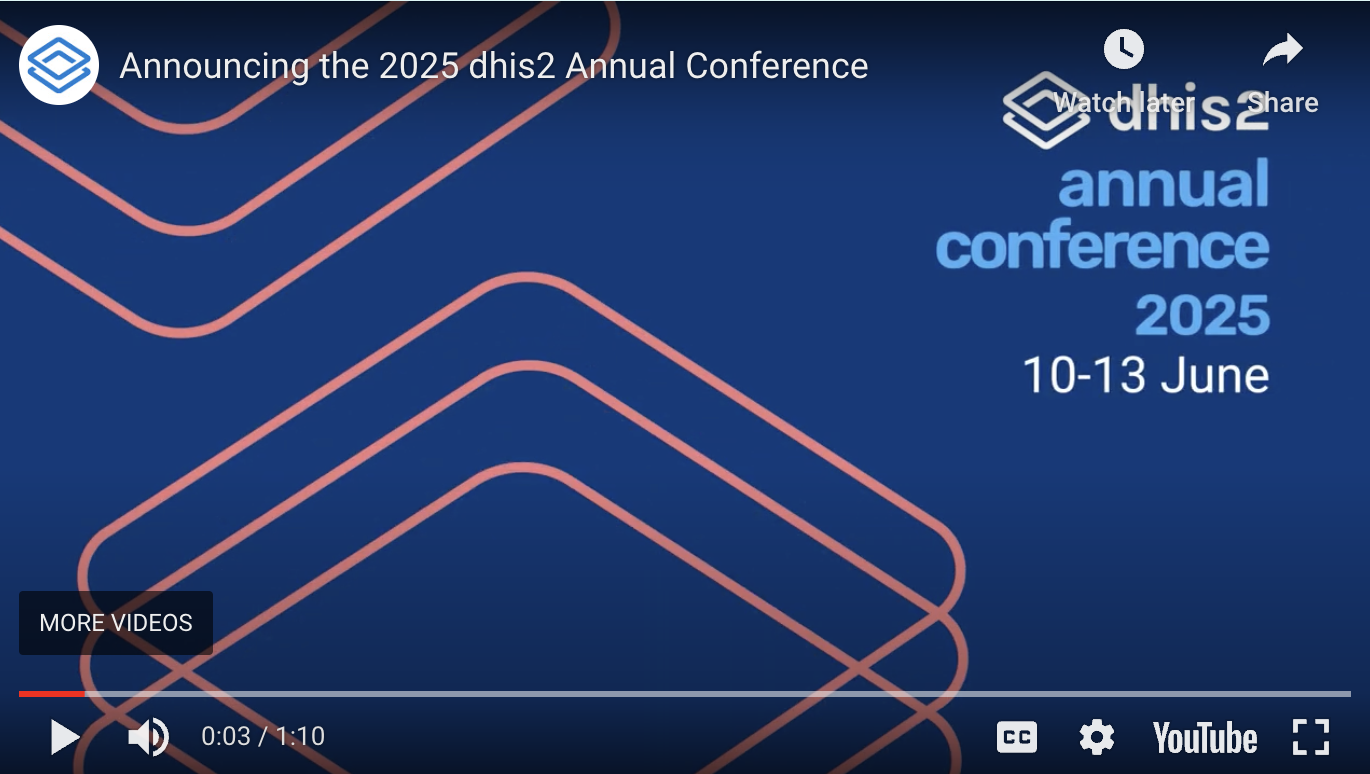
Get ready for four days of learning and inspiration as you experience the world-changing impact of the global DHIS2 community!
The HISP Centre is excited to announce the 2025 DHIS2 Annual Conference, scheduled to take place on 10 - 13 June 2025 at the University of Oslo, Norway.
The DHIS2 Annual Conference—the biggest annual DHIS2 event—brings together decision-makers, ministries and other governmental institutions, donors, implementers and innovators under one roof.
During four days of presentations, technical demonstrations, interactive discussions, and networking sessions, you’ll discover how DHIS2 is leveraged for data-driven solutions responding to some of the most pressing challenges in health, education, climate impacts, logistics, and beyond. This in-person gathering provides the opportunity to share experiences, models and new perspectives, and interact with peers from the around the world.
Early bird registration will open in...
MoreGet ready for four days of learning and inspiration as you experience the world-changing impact of the global DHIS2 community!
The HISP Centre is excited to announce the 2025 DHIS2 Annual Conference, scheduled to take place on 10 - 13 June 2025 at the University of Oslo, Norway.
The DHIS2 Annual Conference—the biggest annual DHIS2 event—brings together decision-makers, ministries and other governmental institutions, donors, implementers and innovators under one roof.
During four days of presentations, technical demonstrations, interactive discussions, and networking sessions, you’ll discover how DHIS2 is leveraged for data-driven solutions responding to some of the most pressing challenges in health, education, climate impacts, logistics, and beyond. This in-person gathering provides the opportunity to share experiences, models and new perspectives, and interact with peers from the around the world.
Early bird registration will open in January 2025 and we invite you to follow #dac2025 on the DHIS2 Community of Practice (CoP) and follow us on social media (Facebook, LinkedIn or Twitter/XTwitter/X) to get the latest event updates and announcements. If you sign up now, you’ll also be among the first to know about our Call for Abstracts, which will open in the coming weeks!
We invite you to save the date for the 2025 DHIS2 Annual Conference, and we hope you will join us next year in Oslo!
Post is under moderationStream item published successfully. Item will now be visible on your stream.
DHIS2 started a new discussion, Webinar: DHIS2 for Mpox surveillance and immunization programsAs Mpox remains a growing global concern, having the right tools for rapid response is more important than ever. In our upcoming Gavi-sponsored webinar on 9 October at 14:00 CET, the University of Oslo HISP Centre team will introduce powerful, open-source, integrated solutions for surveillance and immunization leveraging the DHIS2 platform. In addition, HISP Rwanda and HISP Uganda will present how they supported Ministries of Health in swiftly deploying Mpox surveillance systems, leveraging their existing infrastructure, to stay ahead of the outbreak.We invite you to join us for this webinar to learn more about the available tools and support from the HISP network to strengthen Mpox response. Learn more and register at these links:- Event webpage: https://dhis2.org/events/webinar-dhis2-mpox/
- Community discussion: https://community.dhis2.org/t/upcoming-webinar-on-mpox-surveillance-and-immunization-9-octobre-2024-14-00-cet-english-francais/61231
- Registration: https://us06w...
MoreAs Mpox remains a growing global concern, having the right tools for rapid response is more important than ever. In our upcoming Gavi-sponsored webinar on 9 October at 14:00 CET, the University of Oslo HISP Centre team will introduce powerful, open-source, integrated solutions for surveillance and immunization leveraging the DHIS2 platform. In addition, HISP Rwanda and HISP Uganda will present how they supported Ministries of Health in swiftly deploying Mpox surveillance systems, leveraging their existing infrastructure, to stay ahead of the outbreak.We invite you to join us for this webinar to learn more about the available tools and support from the HISP network to strengthen Mpox response. Learn more and register at these links:- Event webpage: https://dhis2.org/events/webinar-dhis2-mpox/
- Community discussion: https://community.dhis2.org/t/upcoming-webinar-on-mpox-surveillance-and-immunization-9-octobre-2024-14-00-cet-english-francais/61231
- Registration: https://us06web.zoom.us/meeting/register/tZ0qcO6trDIsE91oFKkGQqahplaaaCM4WkYh
We hope you can join us for this event!Max Krafft
Communications Lead
DHIS2 core team
HISP Centre, University of Oslo
dhis2.org | hisp.uio.noPost is under moderationStream item published successfully. Item will now be visible on your stream.
DHIS2 started a new discussion, Using DHIS2 for Improved Cold Chain Equipment Monitoring and Management in MalawiMalawi’s Ministry of Health used DHIS2 Tracker to register and manage its vaccine cold chain equipment, cataloging more than 300 pieces of equipment across 20 districts in only four weeks, and reducing inventory reporting time from years to minutes.
Cold chain equipment and vaccine stock data—two cornerstones of effective nationwide immunization programs—have represented key challenges for Malawi in recent years. Storms have damaged existing cold chain equipment and weakened the electric grid and transportation infrastructure in some areas, and disease outbreaks have further strained cold storage capacity. Additionally, cold chain equipment records in Malawi have commonly used a patchwork of non-standardized, web-based spreadsheets, email messages, and paper forms, which complicate data consolidation and analysis, as well as equipment allocation and maintenance.
Because of its previous success using DHIS2 for Covid-19 surveillance and response, Malawi’s health officials...
MoreMalawi’s Ministry of Health used DHIS2 Tracker to register and manage its vaccine cold chain equipment, cataloging more than 300 pieces of equipment across 20 districts in only four weeks, and reducing inventory reporting time from years to minutes.
Cold chain equipment and vaccine stock data—two cornerstones of effective nationwide immunization programs—have represented key challenges for Malawi in recent years. Storms have damaged existing cold chain equipment and weakened the electric grid and transportation infrastructure in some areas, and disease outbreaks have further strained cold storage capacity. Additionally, cold chain equipment records in Malawi have commonly used a patchwork of non-standardized, web-based spreadsheets, email messages, and paper forms, which complicate data consolidation and analysis, as well as equipment allocation and maintenance.
Because of its previous success using DHIS2 for Covid-19 surveillance and response, Malawi’s health officials decided in 2022 to use the platform to modernize its vaccine cold chain equipment (CCE) management and monitoring. Staff from the Expanded Programme on Immunization (EPI) and the Digital Health Division–with support from UNICEF Malawi–designed and tested a new CCE system in DHIS2, and trained technicians to register and manage CCE items in Tracker. Technicians then registered and tracked more than 300 total pieces of equipment across 20 districts in the span of four total weeks. The improved CCE monitoring in these districts has supported informed resource allocation and maintenance planning as technicians can now view inventory, equipment status, and transactions on their DHIS2 dashboards in real time. Inventory data that once took five years to generate is now available within five minutes.
“The cold chain equipment management system has helped us to access the cold chain inventory, know every transaction that has happened, and help in planning the next due CCE service.” Lucius Future Chisale, cold chain technical assistant, Central East Zone
Identifying workflows and key metadata inform Tracker configuration and CCE technician training
Management of cold chain equipment in Malawi has been paper based, with some standalone electronic spreadsheet files, until very recently, according to Blessings Kamanga, a product manager with the Ministry’s Digital Health Division. He said some cold chain managers made early progress by moving to web-based spreadsheets, but that approach presented challenges as well. “For example, if you want to know stock levels, or maybe operational status, that was very difficult because it means you have to consolidate those individual files and make sure that you can do the analysis on your own in Excel. So, that was a gap,” he explained. Previously, national EPI team members would need to travel to each of the CCE facilities to generate a thorough inventory—a process that typically occurred once every five years—and now that same information can be accessed within five minutes. “Now, within five minutes, we can log in to the system and pull out the data, update the functionality status, or sync data back to the server,” Kamanga said.
An important first step to digitizing and standardizing its workflows for cold chain equipment monitoring and management, the Digital Health Division conducted a thorough review of the hard-copy forms and the various electronic spreadsheets in use. They worked to establish exactly which data items were being collected, and pinpointed the management stages of the existing workflow, which included equipment transactions, operational status, temperature monitoring, and more. “Once you’ve registered the equipment, you may need to dispatch it to some other facility, or you may need to carry out planned or corrective maintenance,” Kamanga said of the CCE processes. “We also need to know if the equipment has triggered an alarm to indicate the temperature has gone beyond the threshold, which would require some action to be taken.”
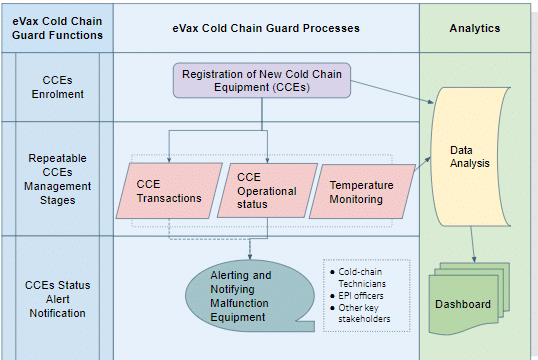
Based on these requirements, the national team designed a process for registering and managing the equipment, and two DHIS2 technicians from the Digital Health Division developed a Tracker program, now called “eVax Cold Chain Guard,” within the national electronic vaccination (eVax) module on Malawi’s One Health Surveillance Platform. After the EPI team completed testing, staff from the Digital Health Division and EPI provided training for cold chain technicians from two targeted districts—Lilongwe and Ntchisi. They gave a brief orientation, demonstrating how to register, monitor, and manage CCE items in the system, and distributed labels with unique identifier quick response (QR) codes to support faster data entry and equipment tracking.
National team provides oversight and support for district-level technicians for successful implementation
Following their orientation with the eVax Cold Chain Guard system in March 2024, CCE technicians from the two districts began registering equipment in their facilities—attaching the QR code labels and entering the corresponding data on mobile devices. In only three weeks, the technicians in these two districts were able to register 200 pieces of equipment in 105 facilities. A week later, those first technicians provided mentoring to technicians in 18 additional districts, who then registered another 100 pieces of equipment in one week, for a combined result of 300 items registered in a total of four weeks.
Throughout the equipment registration process in the first two districts, the national team used a group chat on a popular text messaging app for live troubleshooting and other kinds of implementation assistance, and members of the Digital Health Division and EPI traveled to many of the CCE facilities to monitor progress and resolve any ongoing issues with equipment registration. In one case, the team discovered that some technicians using their own mobile devices for data entry were not able to upload data because of problems with a required field, and took quick action to resolve this by editing the data collection form.
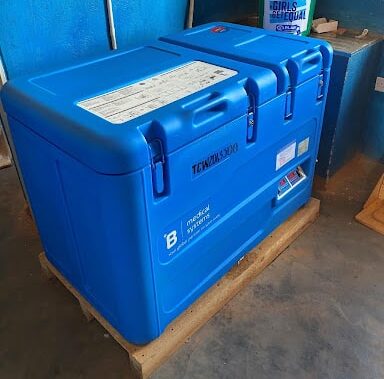
In addition to the use of personal devices for data entry, the team encountered challenges with internet connectivity at some of the more remote facilities. “We used the DHIS2 Android Capture app extensively to make sure the data is collected in those areas,” Kamanga said. While it was not possible to get real-time data in these areas due to lack of connectivity, using this app meant that users could capture the data electronically on site, then upload it to the server as soon as they had network coverage again.
Custom dashboards provide partner transparency and support data-driven resource decisions
As part of the implementation of this CCE system, the Ministry’s Digital Health Division team created dashboards and line lists within eVax Cold Chain Guard to view and analyze various data—including operational status by district, available equipment by facility, types of equipment deployed, equipment with remote temperature monitoring devices, and more. These dashboards provide new functionality for cold chain managers, with real-time insights into equipment availability, maintenance requirements, and cold chain capacity versus actual stored volume.
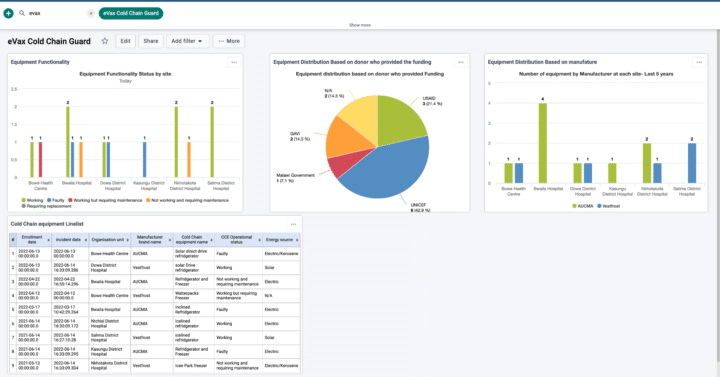
“For each district, we are able to see how many pieces of equipment are functional, how many require maintenance, and how many are not functional,” Kamanga said. “If there’s a need to procure some equipment, we can easily see what kind of equipment to procure.” Because the dashboards also show the funding source for each piece of equipment, “we are able to show transparency and accountability in terms of the equipment that our donors and partners provide to the country,” Kamanga explained. This information can help donors such as Gavi, Unicef, and USAID monitor the effectiveness of their support to Malawi’s health system and prioritize areas for additional funding.
“Data inventory management is now kept in a simple and easily accessed [location] for analyzing and viewing, like CCE models, CCE volume, power usage, etc.” Anock Sinkhonde, Zonal Cold Chain Technical Assistant, South West Zone
Next steps: Expanding to other districts, integrating additional data sources, and onboarding more equipment
Since the initial stages of this CCE management digitization project, the Ministry has continued rolling out the eVax Cold Chain Guard system as part of a new, broader modernization roadmap to be implemented from 2025 to 2027. According to Kamanga, the roadmap supports the expansion of eVax Cold Chain Guard to other districts, as well as the integration of other types of data, including remote temperature monitoring data. “We are looking at carrying out orientations in those other districts, so that we can make sure all of the cold chain equipment is registered,” Kamanga said. “Some of the CCE items are equipped with remote temperature monitoring devices provided by Nexleaf, [and] the idea is to integrate that with the system we have created, so that it is automated.” Additionally, the Ministry hopes to transition the CCE monitoring system to reverse billing, and is considering expanding to include other types of equipment within the healthcare sector.
This article is based on a presentation by Blessings Kamanga at the DHIS2 2024 Annual Conference. Watch the recording on YouTube (begins at 24:26) and view the slides on Google Drive. Hear his perspectives on this project in the video below. To learn more about DHIS2 for Logistics, visit our website.
 Post is under moderationStream item published successfully. Item will now be visible on your stream.There are no activities here yet
Pinned Items
Recent Activities