
How nurse-led, community-rooted HPV vaccination models are strengthening the continuum of cervical cancer elimination
FIELD LESSONS FROM A FOUR-COUNTRY, NURSE- AND MIDWIFE-LED HPV VACCINATION INITIATIVE IN EASTERN AND SOUTHERN AFRICA—AND THEIR IMPLICATIONS FOR INTEGRATED, DIGITALLY ENABLED CERVICAL CANCER PREVENTION
Why now
Cervical cancer remains the fourth most common cancer among women worldwide.
The preventable disease claimed the lives of almost 350,000 women in 2022, more than 90% of them in low- and middle-income countries. However, if caught early, cervical cancer is curable (World Health Organization), and the HPV vaccine administered in early adolescence, is a highly effective prevention intervention. In 2020, 194 countries committed to the WHO Global Strategy to Accelerate the Elimination of Cervical Cancer. Its 90-70-90 targets* there has been progress, HPV vaccination has moved from a peripheral adolescent-health activity to a frontline pillar of primary prevention.
Momentum has been reinforced by WHO's 2022 recommendation permitting a one or two dose schedule for girls aged 9–14, a change expected to make vaccination programmes cheaper, logistically simpler and easier to scale in resource-constrained settings (WHO, 2022a, 2022b). Yet coverage remains stubbornly uneven.
Vaccine introduction has been slow across sub-Saharan Africa (SSA), hampered by unreliable estimates of eligible girls, missed opportunities in routine services, and pockets of hesitancy fuelled by misinformation. In some SSA regions HPV vaccination was disrupted by COVID-19-era service interruptions (Karanja-Chege, 2022).
Rural, out-of-school, disabled, and displaced adolescent girls are those least likely to be reached by routine primary health care and are also those at the highest lifetime risk from cervical cancer. Closing this gap is as much a question of delivery design as of vaccine supply. A five-country, nurse-led field programme
The Africa Action Network for Nurses and Midwives (AAN), generously supported by Direct Relief and private donors, is implementing a portfolio of five HPV vaccination projects across four countries, Uganda, Kenya, Malawi, and Zimbabwe, built around a common design principle: put nurses, midwives, and nursing students at the centre of both sensitization and service delivery working in close partnership with district health authorities and schools.
Against an aggregated target of 12,345 first doses, the programme had delivered 15,081 vaccinations by August 2026, alongside sensitization of many children on HPV and sexual and reproductive health more broadly (AAN, 2026).
• Vaccination*: 90% of girls fully vaccinated with the HPV vaccine by the age of 15;
• Screening: 70% of women screened using a high-performance test by the age of 35, and again by the age of 45;
• Treatment: 90% of women with pre-cancer treated and 90% of women with invasive cancer managed.
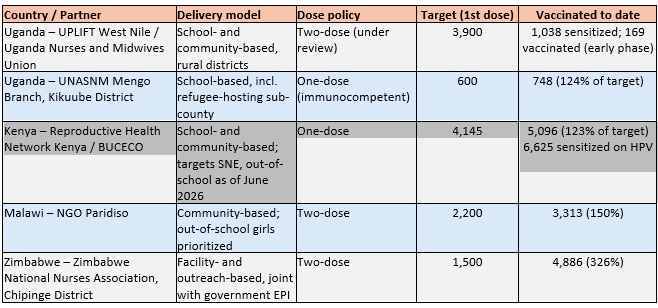
The table below summarizes the delivery models, dose policies, and progress reported across the five projects as of August 2026.
Three results stand out
First, the Zimbabwe project in Chipinge District, run jointly by the Zimbabwe National Nurses Association (ZINA and the Ministry of Health and Child Care Expanded Programme on Immunization, vaccinated 4,886 grade-5 girls against a target of 1,500, achieving 87% coverage of targeted ten-year-olds across 22 health facilities and 55 schools. ZINA combined government-supplied vaccines and health personnel with the association's logistics, fuel and outreach capacity. As the implementers noted, government would have been unable to conduct these outreach activities without that added capacity (AAN, 2026).
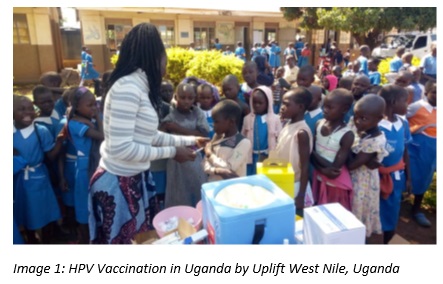
Second, in Kikuube District, Uganda, student nurses from the Mengo School of Nursing and Midwifery, working with AAN Uganda and district health teams, exceeded a 600-girl target by 148, reaching 748 girls across two phases in November 2025 and March 2026.
Third, in Kakamega County, Kenya, the Reproductive Health Network Kenya (RHNK), working with Buyeti Centre for Community Empowerment (BUCECO) and the County Department of Health, exceeded its vaccination target, vaccinating 5,096 girls against a target of 4,145 (123%) across 142 schools. Additionally, RHNK reached 6,625 adolescents through HPV and cervical cancer prevention sensitization activities, reflecting a comprehensive approach that combined school- and community-based health education with vaccination services (AAN, 2026).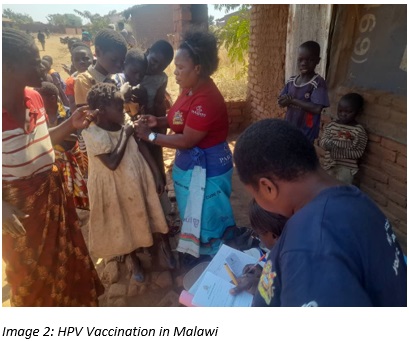
What the delivery models are teaching us
1. School-based versus community-based reach Most projects combine school-based sensitization with vaccination, since schools offer a ready-made, age-appropriate platform for reaching the 9–14-year age band prioritized by national policy. But every project also documents the limits of a school-only approach. Malawi's programme, implemented by NGO Paradiso TB Patients Trust around in Lilongwe's Ngwenya, Area 18, and Area 25 health centres, deliberately prioritized out-of-school girls before turning to school-going girls, precisely because routine, school-anchored campaigns tend to miss them (AAN, 2026).
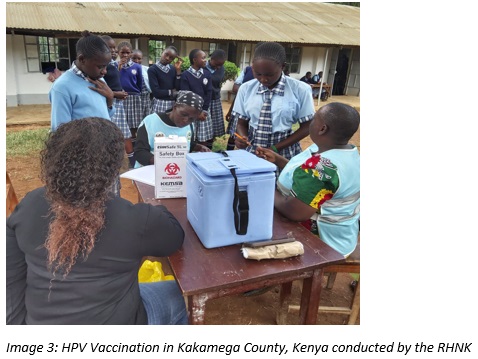
The Reproductive Health Network Kenya and BUCECO project goes further, designing explicit strategies to reach learners in Special Needs Education schools, adolescents with disabilities in home-based care and out-of-school adolescents in Kakamega County, after a review of 2025 county data found HPV coverage ranging from 26% to 69% between sub-counties (AAN, 2026).
2. Reaching displaced and hard-to-reach populations In Uganda, the Kikuube District project also illustrates how administrative barriers can block access to the most-vulnerable girls. The implementation team travelled to the Kyangwali refugee settlement with clearance already secured from the district's chief administrative officer and health officer, only to be told at the gate that separate authorization was required from the camp commissioner, based in Kampala, a bureaucratic hurdle the team could not resolve in time and that diverted vaccination activity to schools outside the camp instead (AAN, 2026).
Similarly, in Kakamega County, Kenya, RHNK intentionally designed its implementation strategy to reach populations often missed by routine school-based immunization programmes, including learners in Special Needs Education (SNE) schools, adolescents with disabilities and out-of-school girls. To support this objective, RHNK partnered with BUCECO whose established links to children with disabilities and rural communities, enabled targeted community mobilization and engagement with caregivers. These experiences demonstrate that improving equity in HPV vaccination requires more than vaccine availability; it requires deliberate partnerships, inclusive planning and tailored delivery strategies for populations that face additional barriers to accessing routine services.
3. Demand generation and community trust Across all four countries, sensitization consistently reaches far more children than are ultimately vaccinated. For example, 6,752 primary school children were sensitized against 4,059 girls vaccinated in the initial Kikuube and West Nile campaigns (AAN, 2024). This gap partly reflects age-eligibility (some children sensitized fell outside the 10-year target age), but it also reflects parental hesitancy, a pattern well documented across the region and linked to misinformation, health-system access barriers, and socio-cultural factors that discourage early engagement with reproductive health topics (Karanja-Chege, 2022).
Several projects report that engaging chiefs, Assistant Environmental Health Officers, teachers, and parent-facing community structures before vaccination day materially improves acceptance, underscoring that demand generation is not a one-off information, education and communication activity but a sustained, relationship-based process. In Uganda’s Kikuube District, the implementation team-built sensitization directly into its methodology, meeting with the Chief Administrative Officer, District Health Officer and head teachers at each selected school before any vaccination activity took place and securing documented acceptance letters as a precondition for entry.
Where head teachers and classroom teachers actively backed the campaign, explaining it to pupils, reassuring anxious children and lending their own authority to the health talks, uptake followed; the Kikuube team reported that girls were visibly motivated to get immunized after health education sessions delivered with school leadership support. Conversely, the same report flags parental resistance as an active brake on coverage, with some parents stopping their children from being immunized despite the school's endorsement, underscoring that school-level buy-in and household-level trust are related but distinct hurdles.
This points to a practical lesson for future rounds: sensitization is not preparatory noise ahead of the "real" work of vaccination, it is itself a delivery variable that should be planned, resourced, and measured with the same rigor as dose counts, with school heads and teachers treated as named partners rather than incidental gatekeepers. Integration: the next frontier The strongest long-term case for these projects is that they demonstrate how HPV vaccination can anchor a wider continuum of adolescent and women's health services rather than stand as a vertical, one-off campaign.
Several practical integration opportunities emerge directly from this field experience
● Linking vaccination registers to digital immunization and school-health records, so that girls sensitized but not yet vaccinated and those who move between school-based and community-based systems, including displaced populations are not lost to follow-up.
● Using the same community engagement structures built for HPV sensitization (teachers, community health workers, religious and traditional leaders) to support broader adolescent sexual and reproductive health messaging, as several projects already do.
● Building a data-driven targeting approach, as Kenya's Kakamega project is doing, that uses sub-county coverage data to direct limited resources toward the lowest-coverage, highest-risk areas rather than spreading effort evenly.
● Planning now for the transition of vaccinated cohorts into HPV-based cervical screening as they reach screening age, so today's vaccination platforms become tomorrow's entry point into diagnostics and treatment pathways. This integrated view, vaccination as the entry point to a continuum that also encompasses screening, diagnosis, treatment, and surveillance aligns with WHO's own framing of HPV vaccination as one pillar of the 90-70-90 elimination strategy, sitting alongside 70% screening coverage and 90% access to treatment for pre-cancerous and invasive disease (WHO). Digital tools, electronic immunization registries, GIS mapping of coverage gaps, and simple dashboards of sensitized-versus-vaccinated ratios offer a low-cost way for community-led programmes like AAN's to identify missed opportunities in close to real time.
Recommendations
For governments:
● Adopt single-dose schedules where evidence and supply conditions allow us to reduce the logistical burden documented across every project in this programme.
● Pre-authorize multi-agency access protocols for refugees and other displaced-population settings before campaigns are planned, not after teams arrive at the gate.
For donors and implementers:
● Fund integrated, multi-year engagement given how much of each project's success depended on sustained relationship-building with district officials, school leadership, and community structures.
● Invest in lightweight digital tracking so that the gap between children sensitized and girls vaccinated, a consistent pattern across all five countries, can be measured, understood, and closed over successive campaign rounds.
● Invest in community-led demand generation through community health promoters, teachers, parents and local champions, as these approaches proved effective in addressing misinformation and improving HPV vaccine uptake.
For researchers:
● Document comparative cost-effectiveness and coverage outcomes across school-based, facility-based, and community-outreach models.
Conclusion
The AAN experience across Uganda, Kenya, Malawi, and Zimbabwe shows both what nurse- and midwife-led HPV vaccination can achieve at the margins of formal health systems, in close collaboration with reliable international partners, such as Direct Relief, and how much further coverage, equity, and integration can still go.
The task ahead is not only to vaccinate more girls, but to knit vaccination, screening, and treatment into a single continuum of care supported by the community trust, front-line health workers, and increasingly the digital tools that these projects are already putting to work.
------
Authors
Lead author: Elvis Safary, Head of Women's Health Programme, FIND - https://www.finddx.org/
Contributors: Annet Kabanyoro, Peason Twinomugisha, Nelly Munyasia and Harriet Chiomba
Acknowledgments
The authors gratefully acknowledge Direct Relief for their generous financial support through the Africa Action Network for Nurses and Midwives (AAN) which made this multi-country HPV vaccination initiative possible.
We also wish to acknowledge the support of the district health authorities, schools and communities across Uganda, Kenya, Malawi, and Zimbabwe for their partnership and trust.
References
Africa Action Network. (2024). AAN nurse-led HPV vaccination campaigns reach more than 6,700 young girls in rural Uganda [Press release]. Africa Action Network for Nurses and Midwives. Africa Action Network. (2026a).
HPV vaccination of schoolgirls: Direct Relief status report, 18 March 2026. Africa Action Network for Nurses and Midwives.
Africa Action Network. (2026b).
Implementation report for Africa Action Network project on HPV vaccination of schoolgirls in Kikuube District, March 2026. Africa Action Network for Nurses and Midwives, Uganda. Karanja-Chege, C. M. (2022). HPV vaccination in Kenya: The challenges faced and strategies to increase uptake. Frontiers in Public Health, 10, Article 802947.
https://doi.org/10.3389/fpubh.2022.802947 World Health Organization. (n.d.). Cervical Cancer Elimination Initiative. Retrieved July 22, 2026, from https://www.who.int/initiatives/cervical-cancer-elimination-initiative World Health Organization. (2022a, April 11).
One-dose Human Papillomavirus (HPV) vaccine offers solid protection against cervical cancer [News release]. https://www.who.int/news/item/11-04-2022-one-dose-human-papillomavirus-(hpv)-vaccine-offers-solid-protection-against-cervical-cancer World Health Organization. (2022b, December 20). WHO updates recommendations on HPV vaccination schedule [News release]. https://www.who.int/news/item/20-12-2022-WHO-updates-recommendations-on-HPV-vaccination-schedule